

Sell Your Work at Conventions
Make the most of your space and investement

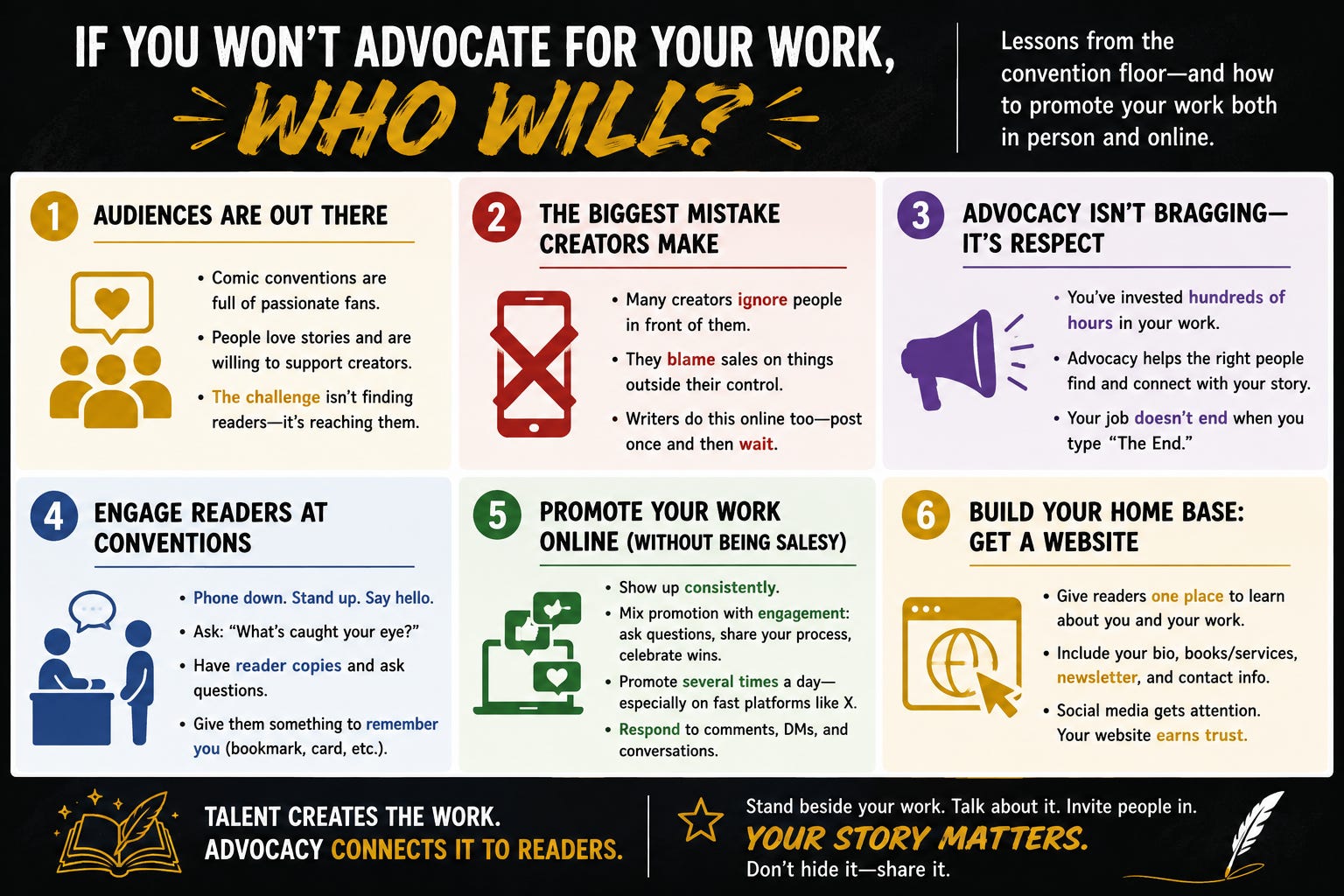
If You Won’t Advocate for Your Work, Who Will?
In a Nutshell
Finishing your book is only half the job. Whether you're selling at conventions or promoting online, authors have to become advocates for their own work. This article explores lessons I learned at Bell County Comic-Con, practical ways to engage readers in person, and simple strategies for building an audience online without feeling like you're constantly selling.
I will likely ramble in this article.
One of the things I’ve genuinely enjoyed this year has been attending comic conventions. I recently came back from Iconic Comics at Bell County Comic-Con, and every convention I attend leaves me with something new to think about. Sometimes it’s a conversation with a reader, sometimes it’s a business lesson, and other times it’s a reminder of what it actually takes to build a creative career.
Someone at the convention mentioned that they believed comics were a dead medium. I smiled when they said it because that hasn’t been my experience at all. Every convention I’ve attended has been filled with passionate fans who genuinely love comics, novels, games, art, and storytelling. People were excited to meet creators, discover new series, and spend money on work they connected with.
To be fair, conventions naturally attract people who already have an interest in these hobbies, so they aren’t a perfect representation of the general public. Still, it’s hard for me to walk through aisles full of enthusiastic readers and conclude that creativity is dying. If anything, I come away feeling the opposite. People are still hungry for good stories. The challenge isn’t that audiences don’t exist; it’s getting your work in front of them.
That realization led me to something else I noticed throughout the weekend. As I wandered around the convention floor to stretch my legs between conversations, I started paying attention to how different vendors interacted with the people walking by. Some booths were alive with energy. The creators greeted visitors, smiled, answered questions, and invited people to take a look. Other booths couldn’t have felt more different.
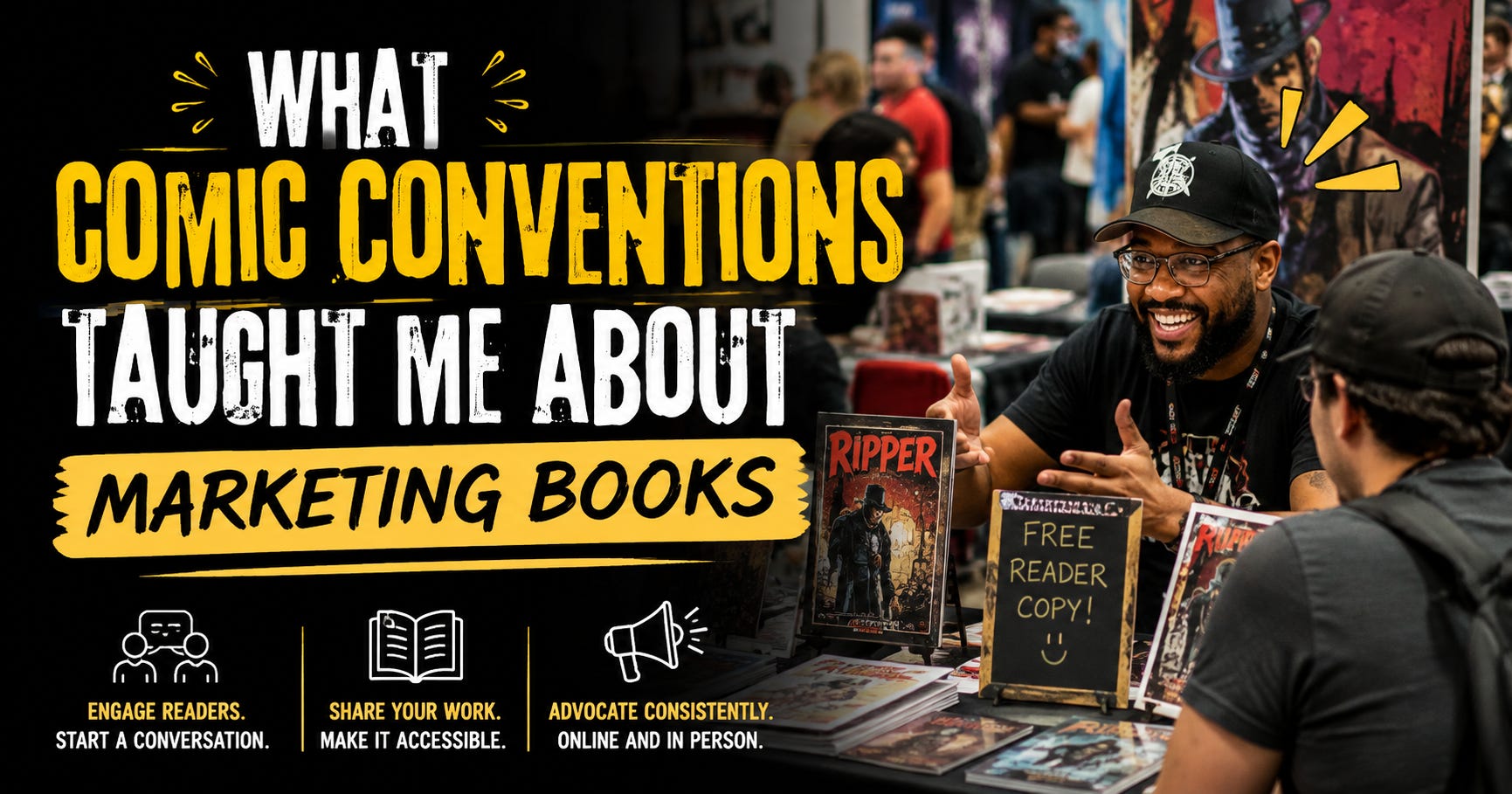
What Comic Conventions Taught Me About Marketing Books
More than once, I approached a booth where the creator never acknowledged me. They were sitting behind their table scrolling through their phone, and occasionally they would glance up for a second before returning to whatever was on their screen. There was no greeting, no invitation, and no conversation. I wasn’t the only person they ignored, either.
It didn’t matter whether they were selling comics, novels, artwork, crafts, or collectibles. The products were different, but the outcome was the same: nobody stopped.
Later, I heard some of these same vendors talking about disappointing sales. The explanations were familiar. The economy was bad, foot traffic wasn’t great, their table location wasn’t ideal, or people simply weren’t buying this year. Maybe some of those things were true, but almost nobody mentioned the one factor they actually controlled. They weren’t engaging the people standing right in front of them.
That isn’t meant as criticism for the sake of criticism. It’s an important reminder because writers fall into this exact same trap online every single day. We spend months, and sometimes years, creating something we’re proud of. We pour ourselves into our books, and then launch day arrives. We make a handful of social media posts and quietly wait for readers to discover us.
When they don’t, we blame the algorithm, Amazon, publishing, oversaturation, or the lack of a marketing budget. Sometimes those things absolutely matter. The publishing landscape is competitive, and there are countless external factors that influence sales. Pretending otherwise wouldn’t be honest, but none of those realities remove our responsibility to advocate for our work.
If you’re willing to invest hundreds of hours writing a novel, shouldn’t you also be willing to spend time helping readers find it? That isn’t selling out. It’s respecting your own effort.
One of the biggest mindset shifts I’ve had over the past few years is realizing that advocacy isn’t bragging. Advocacy is simply helping the right people discover something that might genuinely entertain them, inspire them, or improve their lives. If you believe your story is worth reading, there is no reason to hide it.
Readers can’t fall in love with characters they’ve never met, recommend books they’ve never heard of, or support an author they never knew existed. Your job isn’t finished when you type “The End.” In many ways, that’s when the next phase begins.
Advocating for your work doesn’t require becoming the loudest person in the room. It doesn’t mean shouting at strangers or constantly asking people to buy your book. The best advocacy often looks surprisingly ordinary. It means smiling when someone walks toward your table instead of looking at your phone. It means being willing to say hello, ask what kinds of stories they enjoy, and speak with genuine excitement about the world you’ve spent years building.
Online, it means showing up consistently instead of only posting when your book goes on sale. You can share behind-the-scenes insights, talk about your writing process, celebrate milestones, discuss books you love, or teach something you’ve learned. The goal is to give readers reasons to know, like, and trust you long before you ever ask them to purchase something.
People rarely buy because they saw one advertisement. They buy because they developed confidence in the creator behind the work, and every interaction is an opportunity to build that relationship. That also means remembering that every conversation doesn’t need to end in a sale. Some people simply aren’t your audience, and that’s okay. The goal isn’t to convince everyone to buy your book. The goal is to help the right readers discover that your work exists.
Those readers are out there, and your responsibility is to make meeting them a little easier. The convention floor reminded me that talent alone isn’t enough. I saw incredible artists, skilled writers, beautiful products, and creative ideas all competing for attention. The creators who consistently drew people in weren’t always the most famous or the most experienced. They were often the ones willing to stand up, smile, make eye contact, and invite someone into a conversation.
That’s a lesson every writer can take home. Your work and your business deserve your advocacy. Nobody will ever care about your work as much as you do, and that’s exactly why you have to become its first and most passionate supporter.
If you’re willing to invest your time, creativity, and heart into making something meaningful, don’t stop one step before the finish line. Stand beside your work, talk about it, share it, and invite people into it. The stories that change someone’s life rarely do so while hidden behind a phone screen.
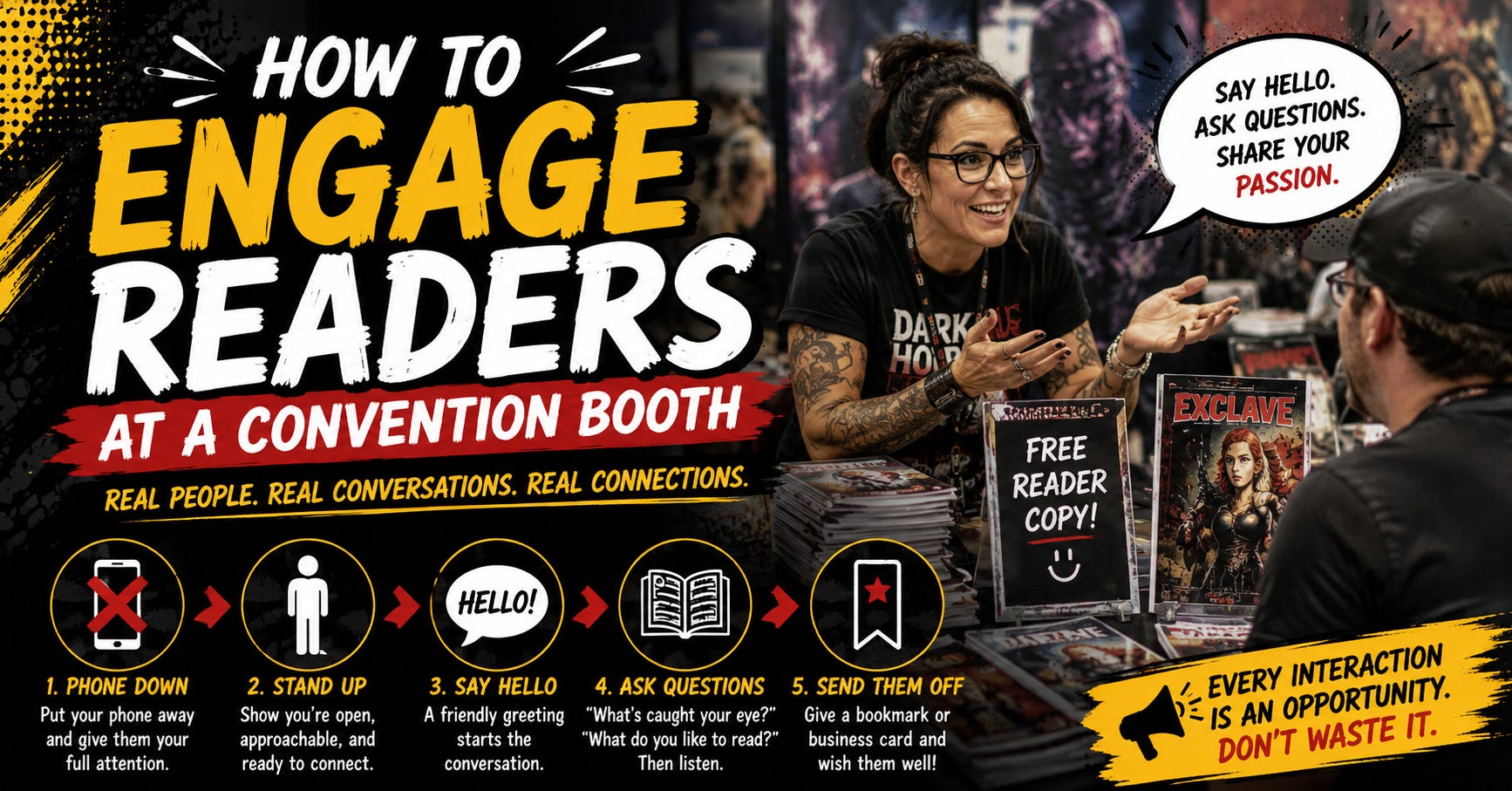
How to Engage Readers at a Convention Booth
So, what does advocating for your work actually look like when someone is standing right in front of your table? It starts with three incredibly simple actions: put your phone away, stand up, and say hello. Those three things alone immediately make you more approachable than a surprising number of vendors I saw throughout the weekend. People are much more likely to engage with someone who looks excited to be there than someone who appears distracted or unavailable. Body language communicates long before words ever do, and if you’re buried in your phone, you’re unintentionally telling potential customers that whatever is on your screen is more important than the person standing in front of your booth.
Once you’ve made that initial connection, resist the temptation to immediately launch into a sales pitch. Your goal isn’t to convince someone to buy something within the first ten seconds. Your goal is to start a conversation. If someone slows down enough to look at one of your covers, they’ve already shown you that something caught their attention. That’s your invitation to engage. One of my favorite questions is incredibly simple: “What’s caught your eye?” More often than not, they’ll answer with something like, “Oh, I’m just looking.” That’s perfectly fine because it gives you another opportunity to continue the conversation instead of ending it.
If you have reader copies available—and I always recommend bringing them if you’re selling comics—you can respond by saying, “Well, you’re in luck because I’ve got reader copies. If something here caught your eye, I’d love to let you flip through it. Which one were you looking at?” Most people will point to a cover, and now you’ve accomplished something important. Instead of simply walking past your table, they’re holding your work in their hands. That’s a much stronger position than trying to describe a story to someone who is already halfway down the aisle.
As they’re flipping through the pages, keep asking questions instead of talking the entire time. Ask them what kinds of books they enjoy reading or what genres they’re usually drawn toward. Maybe they stopped because the artwork caught their attention, but what they’re really looking for is horror instead of superheroes, fantasy instead of science fiction, or something appropriate for their kids. The more you learn about the person standing in front of you, the easier it becomes to connect them with the book they’re actually going to enjoy. People appreciate feeling like you’re helping them find something they’ll love rather than simply trying to make a sale.
One of my favorite moments this weekend happened while I was helping out at a friend’s booth. Someone slowed down to look at one of his covers, and without really thinking about it, I smiled and asked, “What treasure are you looking at?” He laughed, pointed to the comic that had caught his attention, and immediately started talking about why it stood out to him. That one question opened the door for my friend to step into the conversation and explain the story, introduce the characters, and share what made the book special. Had nobody acknowledged him, there’s a good chance he would have admired the cover for a few seconds and continued walking.
I know this kind of interaction can feel intimidating, especially if you’re naturally introverted. Walking up to complete strangers and starting conversations doesn’t come naturally to everyone, but I promise it becomes easier the more you do it. After a handful of conversations, you stop worrying so much about what you’re supposed to say because you realize you’re simply talking to another person who already showed some level of interest in what you’ve created. You’re not forcing a conversation on someone who wants nothing to do with you. You’re responding to curiosity that already exists.
Now, let’s address the phrase every convention vendor hears dozens of times over the course of a weekend: “I’m going to walk around and come back.” You and I both know that most of the time they aren’t coming back, and that’s okay. They get distracted, they find another booth, they stop for lunch, or they simply forget where they saw you. None of that is personal, and there’s no reason to become discouraged because of it. Instead, think about what you can do before they walk away.
Never let someone leave your booth empty-handed if you can help it. If they aren’t ready to buy, hand them something that gives them a reason to remember you later. For me, that’s usually a bookmark with my website and social media information on it. For someone else, it might be a business card, a postcard, a sampler comic, or a QR code that takes them directly to an online store. Wish them a great convention and send them on their way. Maybe they’ll never look at it again, but maybe they’ll clean out their backpack a week later, find your bookmark, remember your comic, and decide to visit your website. Even if you didn’t make the sale at the convention, you created the opportunity to make that sale later, and that’s far better than allowing the interaction to disappear the moment they walked away.
That’s what advocating for your work really looks like. It isn’t about pressuring people into buying something. It’s about creating opportunities for the right readers to discover your work, remember your name, and reconnect with you when they’re ready. Every conversation is a chance to build that relationship, and every person who stops at your table is an opportunity you shouldn’t waste.
How Writers Can Promote Their Books Online Without Feeling Salesy
Online engagement works a little differently from selling your work in person. You aren’t standing behind a table waiting for someone to stop and look at a cover, so you have to create opportunities for people to notice what you’re doing. That doesn’t mean constantly shouting, “Read my book,” every time you post. It does mean being willing to mention that you’re writing a book, that you have a book available, or that there is a place where people can learn more about your work.
One of the best things you can do is create a routine for how you post online. If you use X, Instagram, Facebook, or another social media platform, you can alternate between posts that promote your work and posts that invite people into a conversation. That balance gives people a reason to follow you beyond a single product while still reminding them that you are a working creative with something to offer.
For example, every Wednesday I post something I call Writer Wednesday. I ask writers and other creatives a question about their process, their habits, or the work they’re developing, and then I give them room to share their answers. Those posts aren’t directly selling one of my books, but they still support my larger presence as a writer and editor. They also help people connect with one another, and sometimes the most valuable thing you can create online is a place where people feel comfortable joining the conversation.
I also promote around four things a day on X. Sometimes I’m talking about the charity book, sometimes I’m promoting work I’ve done with Rippaverse, and sometimes I’m sharing one of my own independent projects. After that, I usually spend my time responding to other people, joining conversations, looking through my feed, and checking my direct messages. I’ve received editing opportunities through X, but those jobs usually don’t come from repeatedly posting an advertisement. They come from people seeing my work, recognizing what I do, and then having a conversation with me privately.
Posting about your work four times a day might sound overwhelming if you aren’t used to promoting yourself, but on a fast-moving platform like X, it’s relatively minor. Posts move through the timeline quickly, and many of the people who follow you won’t see everything you share. You don’t need to assume that one post a day is enough to reach everyone, especially when different followers are online at different times.
You should still avoid repeating the exact same sales message over and over. Instead, give people different ways to become interested in what you’re doing. You can share the cover, talk about a character, post a short excerpt, explain what inspired the story, discuss a challenge you encountered while writing it, or mention a milestone you recently reached. All of those posts advocate for the work without sounding like the same advertisement copied and pasted throughout the day.
Even if you don’t have a finished book yet, you still have something to talk about. Tell people that you’re writing one. Share what the process has been like, what you’re learning, what has been difficult, or what excites you about the project. You don’t have to reveal every detail or spoil the story. You simply have to allow people to see that the work exists and that you care enough about it to keep moving forward.
The important thing is to remember that promotion and engagement aren’t separate from one another. When people ask questions about your work, respond to them. When another writer shares a struggle you understand, join the conversation. When someone comments on your post, acknowledge them instead of treating the platform like a billboard. People are far more likely to support someone they recognize and have interacted with than someone who appears only when they have something to sell.
Why Every Author Needs a Website
The final thing I would recommend is having a website. Social media platforms can help people discover you, but your website gives them a permanent place to learn who you are, see what you’ve created, and find the links that matter. It should include information about your books or services, a short biography, a reliable way to contact you, and clear directions for where someone can purchase or follow your work.
You don’t need an elaborate website with dozens of pages. You need one clear place that represents you professionally and makes it easy for people to take the next step. Social media is where conversations begin, but your website should be where people can find you after the timeline has moved on.
Being on your phone while someone is standing or looking at your table is wild to me.
Absolutely! I hardly ever take a seat when I'm at an event. I am always available, ready to engage in chatting about my books with people passing by. You would not believe the sales I get from simply acknowledging someone who is looking at my books or my banners. They probably would have walked on by had I not asked them what they liked about the banners and handed them a book to look over while I gave them my elevator pitch and geeked out with them over any subjects that brought up that we both enjoy... Always be ready to engage. You can recharge your social and mental batteries AFTER the event.